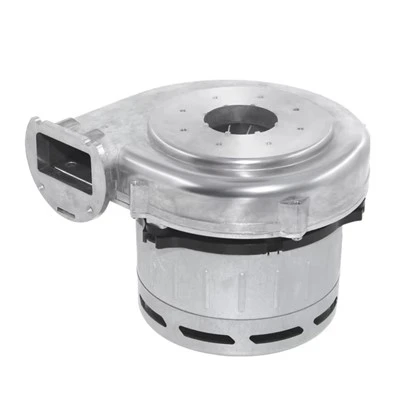
As a trusted supplier of centrifugal exhaust blowers, I've witnessed firsthand how temperature can significantly impact the performance of these essential industrial devices. In this blog, I'll delve into the science behind this relationship, exploring the various ways temperature affects the operation of centrifugal exhaust blowers and offering insights on how to mitigate potential issues.
Understanding Centrifugal Exhaust Blowers
Before we discuss the impact of temperature, it's important to understand how centrifugal exhaust blowers work. These machines use a rotating impeller to accelerate air or gas radially outward from the center of the blower. This creates a pressure difference that draws air into the blower and expels it at a higher pressure. Centrifugal exhaust blowers are commonly used in a variety of applications, including ventilation, air pollution control, and industrial process cooling.
The Effects of Temperature on Centrifugal Exhaust Blowers
Temperature can affect the performance of centrifugal exhaust blowers in several ways, including:
1. Air Density
One of the most significant ways temperature affects centrifugal exhaust blowers is through its impact on air density. As temperature increases, air density decreases. This means that at higher temperatures, there are fewer air molecules per unit volume. Since the performance of a centrifugal exhaust blower is directly related to the mass of air it can move, a decrease in air density can lead to a reduction in the blower's volumetric flow rate and pressure capabilities.
For example, if a centrifugal exhaust blower is rated to deliver a certain volume of air at a specific temperature and pressure, it may not be able to achieve the same performance at a higher temperature. This is because the blower is designed to work with a specific air density, and a change in temperature can disrupt this balance.
2. Motor Performance
Temperature can also affect the performance of the motor that drives the centrifugal exhaust blower. Most motors are designed to operate within a specific temperature range. If the temperature exceeds this range, the motor may experience reduced efficiency, increased wear and tear, and even premature failure.
High temperatures can cause the motor's insulation to degrade, which can lead to electrical shorts and other problems. Additionally, the motor's lubricants may break down at high temperatures, reducing the efficiency of the motor's moving parts. To mitigate these issues, it's important to ensure that the motor is properly sized and cooled for the application.
3. Material Expansion and Contraction
Another way temperature can affect the performance of a centrifugal exhaust blower is through material expansion and contraction. As temperature changes, the materials used in the blower's construction will expand or contract. This can cause misalignment of the blower's components, leading to increased vibration, noise, and wear.


For example, if the impeller of a centrifugal exhaust blower expands due to high temperatures, it may come into contact with the blower's housing, causing damage to both components. To prevent this, it's important to design the blower with proper clearances and to use materials that have similar coefficients of thermal expansion.
4. Lubrication
Temperature can also affect the performance of the lubricants used in the centrifugal exhaust blower. Lubricants are essential for reducing friction and wear between the blower's moving parts. However, high temperatures can cause the lubricants to break down, reducing their effectiveness.
When lubricants break down, they can form deposits and sludge, which can clog the blower's bearings and other components. This can lead to increased friction, heat generation, and wear, ultimately reducing the blower's performance and lifespan. To prevent this, it's important to use high-quality lubricants that are designed to withstand the operating temperatures of the blower.
Mitigating the Effects of Temperature
While temperature can have a significant impact on the performance of centrifugal exhaust blowers, there are several steps that can be taken to mitigate these effects. These include:
1. Proper Sizing
One of the most important steps in mitigating the effects of temperature is to ensure that the centrifugal exhaust blower is properly sized for the application. This means taking into account the temperature and altitude of the installation location, as well as the required flow rate and pressure.
By selecting a blower that is appropriately sized for the application, you can ensure that it will be able to operate efficiently and effectively, even at high temperatures. It's also important to consult with a qualified engineer or blower manufacturer to ensure that the blower is properly installed and maintained.
2. Cooling Systems
Another way to mitigate the effects of temperature is to use cooling systems to keep the blower and its components at a safe operating temperature. This can include using fans, heat exchangers, or other cooling devices to remove heat from the blower.
For example, some centrifugal exhaust blowers are equipped with built-in cooling fans that help to dissipate heat from the motor. Others may use external heat exchangers to cool the air or gas being handled by the blower. By using these cooling systems, you can help to extend the lifespan of the blower and improve its performance.
3. Material Selection
The materials used in the construction of the centrifugal exhaust blower can also play a role in mitigating the effects of temperature. When selecting materials, it's important to choose those that have high thermal stability and low coefficients of thermal expansion.
For example, some blower manufacturers use materials such as stainless steel or aluminum, which are known for their high strength and resistance to corrosion. These materials can also withstand high temperatures without deforming or losing their structural integrity. By using these materials, you can help to ensure that the blower will perform reliably in a variety of operating conditions.
4. Regular Maintenance
Finally, regular maintenance is essential for ensuring the optimal performance of a centrifugal exhaust blower, especially in high-temperature environments. This includes inspecting the blower for signs of wear and damage, cleaning the blower's components, and replacing any worn or damaged parts.
Regular maintenance can also help to identify potential issues before they become major problems. For example, if the blower's bearings are showing signs of wear, they can be replaced before they fail, preventing costly downtime and repairs. By following a regular maintenance schedule, you can help to ensure that the blower will continue to operate efficiently and effectively for many years to come.
Conclusion
In conclusion, temperature can have a significant impact on the performance of centrifugal exhaust blowers. By understanding the ways in which temperature affects these devices and taking steps to mitigate these effects, you can ensure that your centrifugal exhaust blower will operate efficiently and effectively in a variety of operating conditions.
As a supplier of Centrifugal Exhaust Blower, we offer a wide range of high-quality blowers that are designed to withstand the challenges of high-temperature environments. Our 120V High Pressure BLDC Air Blower and BLDC Suction Blower are just a few examples of the products we offer.
If you're interested in learning more about our centrifugal exhaust blowers or have any questions about how temperature can affect their performance, please don't hesitate to contact us. We'd be happy to discuss your specific needs and help you find the right solution for your application.
References
- ASHRAE Handbook - Fundamentals. American Society of Heating, Refrigerating and Air-Conditioning Engineers, Inc.
- Perry's Chemical Engineers' Handbook. McGraw-Hill Education.
- Fluid Mechanics and Thermodynamics of Turbomachinery. S. L. Dixon and C. A. Hall. Butterworth-Heinemann.