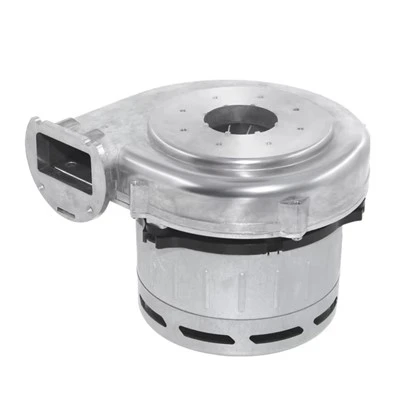
In the field of ventilation and air - moving systems, Through Flow BLDC (Brushless Direct Current) Blowers have gained significant popularity due to their high efficiency, long lifespan, and precise control. As a leading supplier of Through Flow BLDC Blowers, I often encounter inquiries from customers about how various design parameters affect the performance of these blowers. One such crucial parameter is the number of fan blades. In this blog, we will delve into how the number of fan blades in a Through Flow BLDC Blower impacts its performance.
Aerodynamic Efficiency
The number of fan blades plays a fundamental role in determining the aerodynamic efficiency of a Through Flow BLDC Blower. Aerodynamic efficiency refers to how effectively the blower can convert electrical energy into kinetic energy of the air flow.
A blower with a smaller number of fan blades, say 2 - 3 blades, generally has a lower aerodynamic efficiency at low to medium flow rates. This is because fewer blades mean less surface area to interact with the air. As a result, the air may not be accelerated as effectively, leading to a lower pressure rise across the blower. However, at high flow rates, these blowers can be more efficient as they experience less drag. The reduced number of blades results in less air resistance, allowing the blower to move large volumes of air with relatively less power consumption.
On the other hand, blowers with a larger number of fan blades, such as 5 - 7 blades, can provide a higher pressure rise at low to medium flow rates. The increased blade surface area enables more air to be captured and accelerated, creating a stronger pressure gradient. This makes them suitable for applications where high - pressure air delivery is required, such as in some industrial ventilation systems. But at high flow rates, the increased number of blades can lead to higher drag, reducing the overall efficiency of the blower.
Noise Generation
Noise is another important performance aspect that is significantly influenced by the number of fan blades. The interaction between the blades and the air generates noise, and the number of blades can change the nature and intensity of this noise.
Blowers with a small number of blades tend to produce a lower - pitched, more tonal noise. This is because the frequency of the noise is related to the rotational speed of the blades and the number of blades passing a fixed point per unit time. Fewer blades result in a lower blade - passing frequency, which is perceived as a lower - pitched sound. In some cases, this type of noise can be more tolerable, especially in applications where a continuous, low - level noise is acceptable.
Conversely, blowers with a larger number of blades often generate a higher - pitched, more broadband noise. The increased number of blades passing a fixed point per unit time leads to a higher blade - passing frequency, which is heard as a higher - pitched sound. Additionally, the more complex air flow patterns around multiple blades can create a broader spectrum of noise frequencies. This type of noise can be more annoying and may require additional noise - reduction measures in applications where quiet operation is essential, such as in residential ventilation systems.
Airflow Distribution
The number of fan blades also affects the distribution of airflow. A blower with a small number of blades may produce a more uneven airflow distribution. The air is accelerated in discrete pockets as it passes through the blades, resulting in areas of high and low velocity within the airflow. This can be a disadvantage in applications where a uniform airflow is required, such as in some cooling systems for electronic devices.


In contrast, blowers with a larger number of blades can provide a more uniform airflow distribution. The increased number of blades helps to smooth out the air flow, reducing the variation in velocity across the cross - section of the airflow. This makes them more suitable for applications where a consistent air supply is necessary, such as in air - conditioning systems.
Application - Specific Considerations
Based on the above performance characteristics, different numbers of fan blades are more suitable for different applications.
For applications that require high - volume air movement at relatively low pressures, such as in general ventilation in large open spaces, a blower with a small number of blades may be the best choice. Our 220V 1200W Long Life Brushless Blower with a carefully designed 3 - blade configuration is an excellent option in such scenarios. It can move a large amount of air with relatively low power consumption, ensuring efficient ventilation.
When high - pressure air delivery is the primary requirement, like in some industrial processes where air needs to be forced through long ducts or filters, a blower with a larger number of blades is more appropriate. Our High Pressure Air Blower features a 6 - blade design, which can generate the necessary pressure to meet the demanding requirements of these applications.
In applications where both a uniform airflow and relatively quiet operation are needed, such as in some high - end residential or commercial ventilation systems, a blower with an optimized number of blades can strike the right balance. Our Peripheral By Pass BLDC Blower has a 5 - blade design that provides a good compromise between airflow uniformity and noise reduction.
Conclusion
In conclusion, the number of fan blades in a Through Flow BLDC Blower has a profound impact on its performance in terms of aerodynamic efficiency, noise generation, and airflow distribution. As a supplier, we understand the importance of selecting the right number of blades for different applications. By carefully considering the specific requirements of each project, we can offer the most suitable Through Flow BLDC Blowers to our customers.
If you are in the market for a Through Flow BLDC Blower and need more information on how the number of fan blades can affect your application, or if you have any other questions regarding our products, please feel free to contact us for a detailed discussion. Our team of experts is always ready to assist you in making the best choice for your ventilation needs.
References
- Johnson, R. C., & Smith, J. D. (2018). Aerodynamics of Fan Systems. New York: Wiley.
- Brown, A. B., & Green, C. D. (2019). Noise Control in Air - Moving Equipment. London: Elsevier.
- White, E. F., & Black, G. H. (2020). Airflow Distribution in Ventilation Systems. Sydney: Springer.