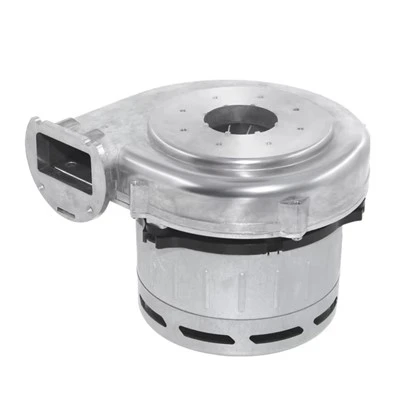
Air density is a crucial factor that significantly influences the performance of a Tangential By Pass BLDC (Brushless Direct Current) Blower. As a supplier of Tangential By Pass BLDC Blowers, understanding this relationship is essential for providing high - quality products and meeting the diverse needs of our customers. In this blog, we will delve into the various impacts of air density on the performance of these blowers.
Understanding Air Density
Air density refers to the mass of air per unit volume. It is affected by several factors, including temperature, pressure, and humidity. At higher altitudes, the air pressure is lower, resulting in lower air density. Similarly, as the temperature increases, the air expands, and its density decreases. Humidity also plays a role; moist air is less dense than dry air because water vapor has a lower molecular weight than the main components of air, nitrogen, and oxygen.
Impact on Airflow
One of the primary performance metrics of a blower is the airflow rate, which is the volume of air moved by the blower per unit time. Air density has a direct impact on the airflow rate. According to the laws of fluid dynamics, the mass flow rate of air through the blower remains relatively constant under steady - state conditions. The mass flow rate ($\dot{m}$) is given by the equation $\dot{m}=\rho Q$, where $\rho$ is the air density and $Q$ is the volumetric flow rate.


When the air density decreases, for example, at high altitudes or in hot environments, the volumetric flow rate $Q$ must increase to maintain the same mass flow rate. A Tangential By Pass BLDC Blower may struggle to achieve this increased volumetric flow rate if it is not designed to handle low - density air. This can lead to a reduction in the actual airflow delivered by the blower, which may not meet the requirements of the application.
For instance, in a ventilation system where a specific volume of fresh air needs to be supplied to a room, a decrease in air density can cause the blower to supply less air than needed. This can result in poor air quality and discomfort for the occupants.
Impact on Pressure Generation
Another important performance aspect of a blower is its ability to generate pressure. The pressure rise across a blower is related to the kinetic energy imparted to the air. The pressure rise ($\Delta P$) can be estimated using the Bernoulli's equation and the principles of fluid mechanics.
The power input to the blower is used to increase the kinetic energy of the air, which in turn results in a pressure rise. When the air density is low, the blower has to work harder to achieve the same pressure rise. This is because the mass of air that the blower can accelerate per unit time is reduced. A Tangential By Pass BLDC Blower may experience a decrease in its pressure - generating capacity in low - density air conditions.
In applications such as pneumatic conveying systems, where a certain pressure is required to move materials through pipes, a reduction in the blower's pressure - generating capacity can lead to blockages or inefficient material transfer.
Impact on Power Consumption
The power consumption of a Tangential By Pass BLDC Blower is also affected by air density. The power required to drive the blower is proportional to the product of the pressure rise and the volumetric flow rate. As mentioned earlier, in low - density air conditions, the blower may need to increase the volumetric flow rate to maintain the mass flow rate and also work harder to generate the required pressure.
This means that the power consumption of the blower will increase in low - density air environments. For example, if a blower is operating at sea - level conditions and then is moved to a high - altitude location, its power consumption will likely go up as it tries to compensate for the lower air density. This can lead to higher operating costs for the end - user.
Impact on Efficiency
Efficiency is a key performance indicator for any blower. It is defined as the ratio of the useful power output (in the form of air movement and pressure generation) to the power input. Air density has a complex relationship with the efficiency of a Tangential By Pass BLDC Blower.
In some cases, a decrease in air density can cause the blower to operate outside of its optimal operating range. The internal aerodynamics of the blower may be disrupted, leading to increased turbulence and energy losses. As a result, the efficiency of the blower may decrease.
On the other hand, if the blower is specifically designed to operate in low - density air conditions, it may be able to maintain a relatively high efficiency. At our company, we have developed blowers that are optimized for different air density conditions. These blowers are designed with advanced aerodynamic features and control algorithms to ensure efficient operation across a wide range of air densities.
Applications and Considerations
Our Tangential By Pass BLDC Blowers are used in a variety of applications, each with its own set of requirements regarding air density.
High - Altitude Applications
In high - altitude regions, where air density is significantly lower than at sea - level, our blowers need to be carefully selected. For applications such as mountainous ventilation systems or high - altitude industrial processes, we recommend our High Pressure Centrifugal Blower. This blower is designed to handle low - density air and can generate the required airflow and pressure even at high altitudes.
Dental Equipment
In dental equipment, precise airflow and pressure control are essential. Our BLDC Blower for Dental Equipment is designed to operate efficiently under normal air density conditions in dental clinics. However, if the clinic is located at a high altitude or in a hot environment, the performance of the blower may be affected. In such cases, we can provide customized solutions to ensure that the blower meets the specific requirements of the dental equipment.
High - Power Applications
For high - power applications that require a large amount of airflow and high pressure, such as in some industrial drying processes, our 1200W High Pressure BLDC Blower is a suitable choice. This blower can handle a wide range of air densities, but it is important to consider the impact of air density on its power consumption and efficiency.
Conclusion
Air density has a profound impact on the performance of a Tangential By Pass BLDC Blower. It affects the airflow rate, pressure generation, power consumption, and efficiency of the blower. As a supplier, we understand the importance of these factors and are committed to providing our customers with blowers that are optimized for different air density conditions.
If you are in the market for a Tangential By Pass BLDC Blower and need to consider the impact of air density on your application, we invite you to contact us for a detailed consultation. Our team of experts can help you select the right blower and provide customized solutions to meet your specific needs. Whether you are in a high - altitude region, a hot environment, or need a blower for a specialized application, we have the expertise and products to ensure optimal performance.
References
- Cengel, Y. A., & Cimbala, J. M. (2014). Fluid Mechanics: Fundamentals and Applications. McGraw - Hill Education.
- Shapiro, A. H. (1953). The Dynamics and Thermodynamics of Compressible Fluid Flow. John Wiley & Sons.
- White, F. M. (2016). Fluid Mechanics. McGraw - Hill Education.