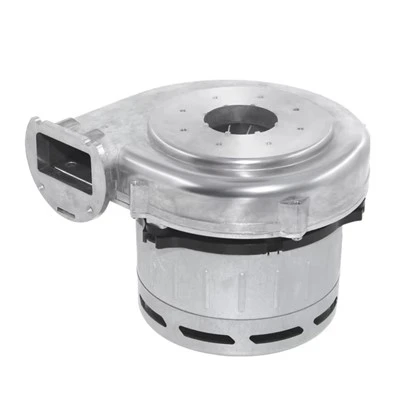
In the realm of motor technology, High Speed Brushless DC (BLDC) motors stand out for their efficiency, reliability, and high - performance capabilities. As a leading supplier of High Speed BLDC motors, I am frequently asked about the concept of back - EMF in these motors. In this blog, I will delve into what back - EMF is, its significance in High Speed BLDC motors, and how it impacts the overall performance of these remarkable machines.
Understanding the Basics of Back - EMF
Back - EMF, or back electromotive force, is a fundamental electrical phenomenon that occurs in electric motors. According to Faraday's law of electromagnetic induction, when a conductor moves through a magnetic field, an electromotive force is induced in the conductor. In the context of a BLDC motor, the rotation of the motor's rotor causes the stator windings to cut through the magnetic lines of force produced by the permanent magnets on the rotor. This induces a voltage in the stator windings, which opposes the applied voltage that is driving the motor.
Mathematically, Faraday's law can be expressed as (E = -N\frac{d\Phi}{dt}), where (E) is the induced EMF, (N) is the number of turns in the coil, and (\frac{d\Phi}{dt}) is the rate of change of magnetic flux through the coil. The negative sign indicates that the induced EMF opposes the change in magnetic flux that causes it.
Back - EMF in High Speed BLDC Motors
In High Speed BLDC motors, back - EMF plays a crucial and multi - faceted role. First and foremost, the magnitude of the back - EMF is directly proportional to the speed of the motor. As the motor spins at higher speeds, the rate at which the stator windings cut through the magnetic field increases, resulting in a higher back - EMF. This relationship can be described by the equation (E_b=k\Phi\omega), where (E_b) is the back - EMF, (k) is a motor - specific constant, (\Phi) is the magnetic flux, and (\omega) is the angular velocity of the motor.
This speed - back - EMF relationship has a significant impact on the motor's performance. At start - up, when the motor is stationary, the back - EMF is zero because there is no relative motion between the stator windings and the magnetic field. As a result, the full applied voltage is used to overcome the resistance of the stator windings and start the motor rotating. As the motor gains speed, the back - EMF increases, reducing the net voltage across the stator windings. This, in turn, limits the current flowing through the windings.
The current in the motor is determined by the difference between the applied voltage ((V)) and the back - EMF ((E_b)) divided by the resistance of the stator windings ((R)), as given by the equation (I=\frac{V - E_b}{R}). In a high - speed operation, the back - EMF can become quite large, approaching the value of the applied voltage. This self - regulating mechanism helps prevent excessive current flow in the motor, which could otherwise cause overheating and damage to the windings.
Importance of Back - EMF in Motor Control
Back - EMF is also a critical parameter in the control of High Speed BLDC motors. Many control algorithms rely on the measurement of back - EMF to determine the position of the rotor. Since the back - EMF waveform is related to the position of the rotor, by monitoring the back - EMF, the controller can accurately switch the current in the stator windings at the right time to ensure smooth and efficient motor operation.
For example, in sensorless control strategies, which are commonly used in High Speed BLDC motors to reduce cost and increase reliability, the back - EMF is used as a substitute for physical position sensors such as Hall effect sensors. The controller analyzes the zero - crossing points of the back - EMF waveform to determine when to change the commutation sequence of the motor. This way, the motor can operate without the need for additional sensors, while still achieving high - precision control.
Impact of Back - EMF on Motor Efficiency
The relationship between back - EMF and motor efficiency is another important aspect. High Speed BLDC motors are known for their high efficiency, and back - EMF plays a key role in this. As mentioned earlier, the back - EMF limits the current in the motor, which reduces the power losses due to the resistance of the stator windings ((P = I^{2}R)). By keeping the current in check, the motor can operate more efficiently, converting a larger proportion of the electrical input power into mechanical output power.
Moreover, a well - designed motor with an appropriate back - EMF characteristic can minimize the energy losses associated with switching and commutation. For instance, when the back - EMF waveform is properly shaped, it can reduce the switching stresses on the power electronics driving the motor, leading to lower losses in the drive circuit and overall improved system efficiency.
Examples of Our High - Performance High Speed BLDC Motors
As a supplier of High Speed BLDC motors, we offer a wide range of products that leverage the principles of back - EMF to deliver exceptional performance. For example, our 3 Phase 310V BLDC Motor is designed to operate at high speeds with high efficiency. The carefully engineered stator and rotor design ensure that the back - EMF is optimized for the specific application, providing reliable and stable operation.


Our 250 Watt BLDC Motor is another excellent option for various high - speed applications. The motor's design takes into account the back - EMF characteristics to provide a high - torque output while maintaining low - power consumption. This makes it suitable for applications where energy efficiency and performance are critical.
For applications requiring a specific speed, our 3000rpm 3 Phase BLDC Motor is an ideal choice. The motor's speed - back - EMF relationship is precisely calibrated to ensure smooth and consistent operation at 3000 rpm, with minimal fluctuations in torque and power.
Conclusion and Call to Action
In conclusion, back - EMF is a fundamental and essential concept in High Speed BLDC motors. It not only affects the motor's performance, efficiency, and control but also plays a key role in ensuring the reliability and longevity of the motor. Understanding the principles of back - EMF can help engineers and designers optimize the performance of their motor - driven systems, whether it's in industrial automation, robotics, or electric vehicles.
If you are in the market for high - quality High Speed BLDC motors or have any questions about the back - EMF of our motors, we encourage you to contact us for a detailed discussion. Our team of experts is ready to assist you in selecting the right motor for your specific application and can provide you with all the technical support you need.
References
- Chapman, S. J. (2012). Electric Machinery Fundamentals. McGraw - Hill.
- Fitzgerald, A. E., Kingsley, C., & Umans, S. D. (2003). Electric Machinery. McGraw - Hill.