


Hey there! As a supplier of BLDC blowers, I often get asked about the cooling methods of these nifty devices. So, I thought I'd take a moment to break it down for you in a way that's easy to understand.
Let's start with the basics. BLDC, or Brushless Direct Current, blowers are becoming increasingly popular in various applications due to their efficiency, reliability, and long lifespan. They're used in everything from HVAC systems to industrial equipment, and even in some consumer electronics. But like any electrical device, they generate heat during operation, and proper cooling is essential to ensure their optimal performance and longevity.
There are several cooling methods commonly used for BLDC blowers, and I'll walk you through each of them.

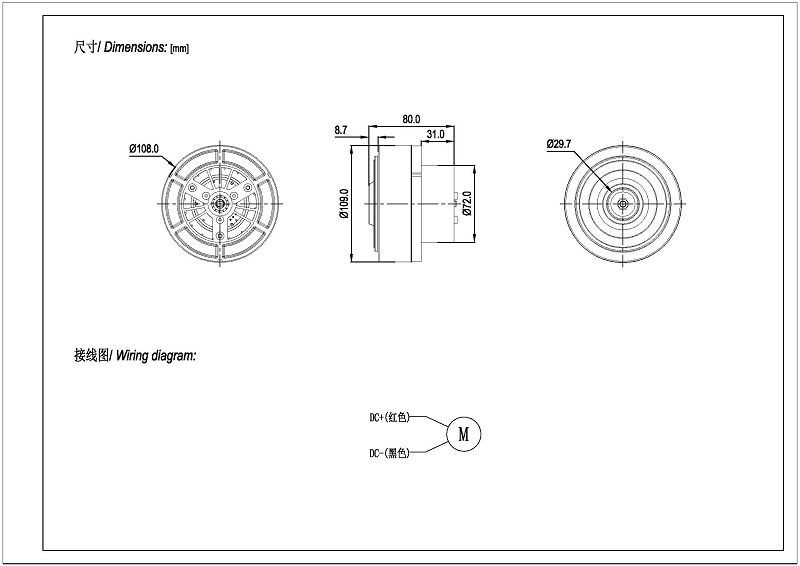
Natural Convection Cooling
Natural convection cooling is the simplest and most basic method. It relies on the natural movement of air caused by the temperature difference between the blower and its surroundings. As the blower heats up, the air around it also warms up and rises, creating a natural airflow that carries the heat away. This method is often used in small, low-power BLDC blowers where the heat generation is relatively low.
The advantage of natural convection cooling is its simplicity and low cost. There are no additional components required, and it doesn't consume any extra power. However, it has its limitations. It's not very effective for high-power blowers or in environments with poor air circulation. In these cases, the heat may not be dissipated quickly enough, leading to overheating and reduced performance.
Forced Air Cooling
Forced air cooling is a more effective method that uses a fan to blow air over the blower. The fan can be either built into the blower itself or an external fan that's installed near the blower. By increasing the airflow around the blower, forced air cooling can significantly improve the heat dissipation rate.
There are two main types of forced air cooling: axial and radial. Axial fans blow air parallel to the axis of the fan, while radial fans blow air perpendicular to the axis. Axial fans are more commonly used in BLDC blowers because they're more efficient at moving large volumes of air at low pressures. Radial fans, on the other hand, are better suited for applications where high pressures are required.
Forced air cooling is widely used in BLDC blowers of all sizes and power ratings. It's more effective than natural convection cooling, especially in high-power applications or in environments with limited air circulation. However, it does require an additional power source for the fan, and the fan itself can generate some noise.
Liquid Cooling
Liquid cooling is the most advanced and effective cooling method for BLDC blowers. It uses a liquid, such as water or a coolant, to absorb the heat from the blower and transfer it to a heat exchanger, where it's dissipated into the surrounding environment. Liquid cooling systems can be either closed-loop or open-loop.
In a closed-loop system, the liquid is circulated through a closed circuit that includes the blower, the heat exchanger, and a pump. The pump keeps the liquid flowing, and the heat exchanger removes the heat from the liquid. Closed-loop systems are more common because they're more efficient and require less maintenance.
In an open-loop system, the liquid is continuously supplied to the blower and then drained away after it has absorbed the heat. Open-loop systems are less common because they require a constant supply of water or coolant, and they can be more difficult to maintain.
Liquid cooling is the most effective cooling method for high-power BLDC blowers or in applications where precise temperature control is required. It can dissipate large amounts of heat quickly and efficiently, and it can also help to reduce the noise level of the blower. However, it's also the most expensive and complex cooling method, and it requires a dedicated cooling system and regular maintenance.
Which Cooling Method is Right for You?
The choice of cooling method for your BLDC blower depends on several factors, including the power rating of the blower, the operating environment, and the specific requirements of your application. Here are some general guidelines to help you make the right decision:
- Low-power blowers: If you're using a small, low-power BLDC blower, natural convection cooling may be sufficient. It's simple, low-cost, and doesn't require any additional components.
- Medium-power blowers: For medium-power BLDC blowers, forced air cooling is usually the best choice. It's more effective than natural convection cooling, and it's relatively simple and inexpensive to implement.
- High-power blowers: If you're using a high-power BLDC blower, liquid cooling may be necessary. It's the most effective cooling method, but it's also the most expensive and complex.
In addition to the power rating of the blower, you also need to consider the operating environment. If the blower will be operating in a hot or humid environment, or in an area with poor air circulation, you may need to choose a more effective cooling method.
Our BLDC Blowers
As a supplier of BLDC blowers, we offer a wide range of products with different cooling methods to meet the needs of our customers. Our 30kPa High Pressure BLDC Blower is a high-performance blower that's designed for applications where high pressures are required. It uses forced air cooling to ensure optimal performance and reliability.
Our 48V High Pressure BLDC Blower is another popular product that's suitable for a variety of applications. It's available with either forced air cooling or liquid cooling, depending on your specific requirements.
If you need a blower that can operate in high-temperature environments, our High Temperature Air Blower is the perfect choice. It's designed to withstand temperatures up to [X] degrees Celsius and uses liquid cooling to ensure reliable operation.
Contact Us
If you're interested in learning more about our BLDC blowers or have any questions about the cooling methods, please don't hesitate to contact us. We'd be happy to help you choose the right blower for your application and provide you with all the information you need.
References
- [List of relevant industry standards or technical papers]
- [Any other relevant sources of information]


